
past STUDENT-LED RESEARCH
Each year, the Montana Water Center awards Montana graduate students with financial support through an annual Water Resource Fellowship Program. To learn more about the past Montana Water Center Fellows, please read about their work below.
2018 STUDENT FELLOWS



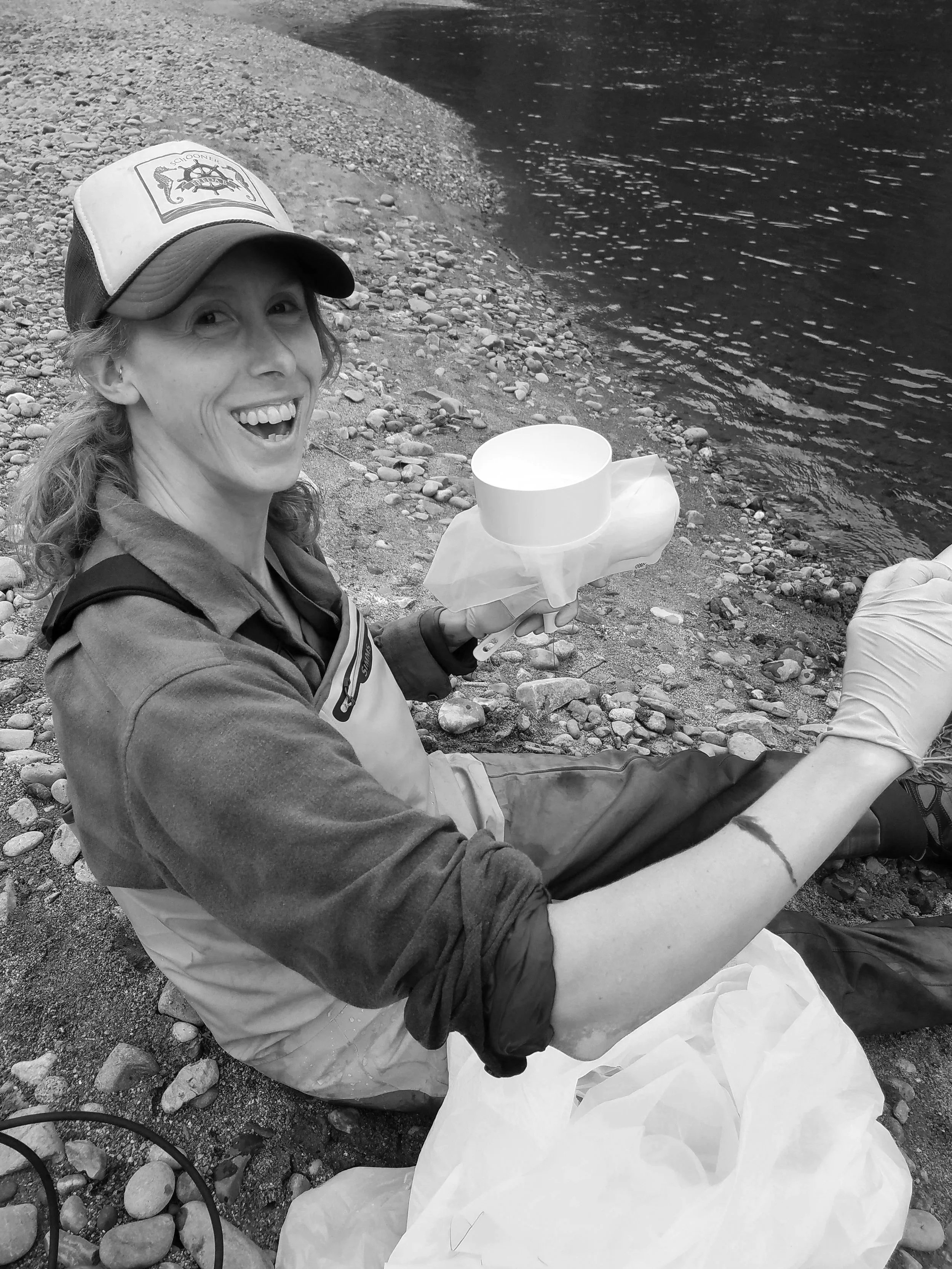


kristen cook: mountain whitefish susceptibility to a myxozoan parasite under thermal stress
Prolific kidney disease (PKD) was responsible for the mass mortality of mountain whitefish in 2016 on the Yellowstone River, Montana. The strong connectivity between temperature and PKD development and mortalities of salmonids suggest climate change will result in increased disease prevalence and severity. The parasite causing PKD, Tetracapsuloides bryosalmonae, is present in several river systems in western Montana and river temperatures are expected to continue to increase.
Kristen Cook, a graduate student at Montana State University, is studying the thermal requirements of juvenile mountain whitefish in the Madison River, Montana, and the susceptibility of this species to T. bryosalmonae under thermal stress.
hannah Koepnick: Microbial reduction of selenium at the Colstrip power plant
Contaminated seepage from coal ash disposal ponds has impacted nearby groundwater at the coal-fired power plant currently managed by Talen Energy in Colstrip, Montana. One of the contaminants of concern is selenium, an essential trace nutrient that becomes toxic at relatively low levels. Selenium toxicity is especially detrimental to aquatic life; in some cases, selenium-polluted waters have resulted in extinction of local fish populations.
Native microbial communities at contaminated sites often have the capacity to reduce dissolved forms of selenium to the insoluble elemental form, thus removing it from the groundwater. Hannah Koepnick, a graduate student at Montana State University, is researching how differences in microbial communities and biogeochemistry impact rates of selenium reduction in affected groundwater around the Colstrip plant. Learning how site conditions influence selenium removal will enable the design of more effective remediation plans.
Miranda Margetts: Measuring drug biomarkers in wastewater to inform targeted public and environment health initiatives for Montana
Over the last decade, assessment of drug biomarkers in wastewater has been undertaken to determine potential exposure to harmful contaminant levels in water, and to determine particular drugs of abuse that are being used within a community. As most pharmaceuticals, including opioids, are not monitored under environmental water quality legislation, there is not yet an established source of data available to public and environmental health officials to gauge the prevalence of drugs flowing through a community. Traditional monitoring methods for epidemiological drug use (i.e., surveys, prescription/dispense data and hospital admission data) are also inherently inaccurate due to the complexities associated with drug use. This project provides an opportunity to establish safety thresholds for toxicological risks to people and the environment while providing anonymity data on individual usage to inform public and environmental health interventions.
In addition to the measurement of waste water influent pre-treatment, post-treatment effluent will also be measured to detect the levels of active pharmaceutical compounds not removed from waste water treatment systems that may lead to cumulative environmental risks to drinking water sources and the environment. This environmental concentration data of particular drugs can assist those agencies tasked with addressing opioid crises and environmental agencies concerned with water quality risks.
Miranda Margetts, a PhD candidate at Montana State University, is co-advised by Dr. Deborah Keil and Dr. Robert Peterson. Miranda is working with Dr. Keil and other MSU colleagues in collaboration with Dr. Heath Wills of Assurity Labs, the Montana Department of Environmental Quality and the Montana Department of Public Health and Human Services to undertake these investigations at various Montanan locations. The various collaborators recognize the utility such data may provide to complement their existing efforts.
Kaitlin perkins: Interactive effects of metal and nutrient cycling in the Upper Clark Fork River
Freshwater pollutants are common in many watersheds across the landscape, as industry, agriculture, and development leave their mark. The Clark Fork River, like many mineral-rich regions across the globe, has a legacy of heavy metal contamination due to historical mining operations. While the Clark Fork Superfund Complex was created to address and remediate mining contamination, restoration efforts are far from complete and metal contamination is still pervasive. Additionally, ranching and agricultural operations along the upper reach of the Clark Fork degrade the riparian zone and contribute contaminants to the river. The combined inputs result in a unique combination of pollutants that are transported down river, manifesting in sediments and aquatic invertebrates far from the Superfund Complex.
Kate Perkins, a PhD student at the University of Montana, is investigating the fate and transport of metal contaminants in the Upper Clark Fork River. She will use field surveys, experimental work, and mesocosms (small-scale experimental streams), to better understand the mechanisms by which metals are transported down river, including the role of microbes. Her research will build upon the legacy of work completed in the Clark Fork River and inform the theory of nanoparticle transport, as well as the effectiveness of efforts to improve water quality in the Clark Fork River.
emma raeside: Understanding root-microbe interactions in the rhizosphere
Treatment wetlands are an accepted method to remove a variety of contaminants from water polluted from a specific source. They are a low-energy low-cost alternative that harness natural biogeochemical processes uniquely inherent to wetland systems. A continued impediment to broader application is a lack of fundamental understanding of how plant roots interact with the biofilm community in the surrounding rhizosphere, where the bulk of the pertinent biogeochemical transformations take place.
Emma, a graduate student at Montana State University, is researching the net influence of oxygen and organic inputs from roots by developing a mechanism to measure in situ dissolved oxygen gradients at and near the root surface. This novel project will be a step towards better understanding the influence of the microenvironment of the rhizosphere for more efficient contaminant removal.
Isaiah Robertson: Limitations to Photosynthesis in Silver Bow Creek
Isaiah Robertson, a graduate student at Montana Tech of the University of Montana, is studying the limitations to photosynthesis in Silver Bow Creek. The study includes a light limitation experiment using in-vivo and extracted chlorophyll for quantification, and metagenomics and metaproteomics for qualification. Isaiah will also be working on one of the first aquatic plant surveys in Silver Bow Creek.