
past STUDENT-LED RESEARCH
Each year, the Montana Water Center awards Montana graduate students with financial support through an annual Water Resource Fellowship Program. To learn more about the past Montana Water Center Fellows, please read about their work below.
2024 STUDENT FELLOWS

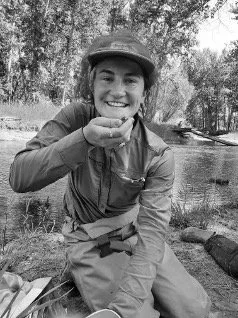


Brooke Bain-White: Investigating How wildfires affect primary productivity and algal community assemblage in mountain lakes.
The mountainous western U.S. is rich in lakes and prone to wildfires, yet we have a limited understanding of how wildfires alter lake ecosystems. The objective of my research, supported by the Montana Water Center, is to investigate how wildfires in lake watersheds alter the physical and chemical environment of lakes and, consequently, the abundance and composition of algae. Specifically, I am examining how lake chemistry, algal abundance, and algal community composition have changed over the past ~500 years. To achieve this, I am using proxies archived in lake sediments to reconstruct past watershed disturbances, shifts in nutrient availability and sources, and changes in algal abundance and community structure. These reconstructions will offer insights into how lakes respond to wildfire and ongoing environmental changes.
Brooke Bain-White (formerly Bannerman) is a PhD candidate at the University of Montana. Brooke is interested in understanding how environmental change influences the ecology of mountain lakes. Her PhD research specifically explores how wildfires affect the chemistry and productivity of lakes in the mountain ranges of the western US. Outside of her academic pursuits, you can find her on foot, bike, or snowboard exploring the mountains.
Bridger Creel: a bird’s eye view: using tree swallows (tachycineta bicolor) to assess the effects of aquatic metal contamination on riparian insectivores in the upper clark fork river superfund site.
Bird populations are declining worldwide, with insectivorous populations shrinking at a faster rate than other groups. Many avian insectivores rely heavily upon emergent aquatic insects that are more nutritious than terrestrial prey types due to the presence of essential highly unsaturated fatty acids. However, this reliance on aquatic prey allows perturbations in aquatic ecosystems to propagate to riparian avian insectivores. In systems impaired by metal contamination (e.g., heavily mined areas), birds can be exposed to aquatic metals via trophic transfer from aquatic insects or metals can lead to a loss of important aquatic prey if insects succumb to metal toxicity before or during metamorphosis. It is simple to predict the effects of a single metal on this aquatic-terrestrial trophic linkage, but ecosystems impaired by mine-waste contamination are commonly afflicted by elevated environmental concentrations of a mixture of many metals. Thus, when a mixture of metals is present in the aquatic ecosystem, it is difficult to predict whether insectivorous riparian songbirds will primarily be affected by metal exposure through their prey, or the loss of nutritionally important aquatic prey. The Upper Clark Fork River (UCFR) in Western Montana represents the largest Superfund site complex in the United States due to aquatic mine-waste contamination in and along the river forming a gradient of metal concentration (primarily Pb, As, Se, Zn, Cu, and Cd). Tree swallows (Tachycineta bicolor) are an aerial insectivore that relies very heavily on aquatic prey and have been used extensively as a model system to study songbird response to perturbation. In the UCFR, we are assessing Tree swallow response to aquatic metal contamination by measuring differences in blood metal concentration, dietary reliance on aquatic prey, breeding success, and two physiological bioindicators of stress across nine sites. Investigating patterns of association between songbird metal accumulation, diet, and tree swallow health/fitness will provide a more holistic understanding of the ecological impacts of mining contamination on riparian consumers.
Bridger Creel received their B.Sc. in Ecology and Evolution from the University of Montana in 2019. In undergrad they gained broad experience in ecology, studying photosynthetic bacteria to African wild dogs. After graduating, they spent several years conducting avian research with The University of Montana Bird Ecology Lab (UMBEL) and Raptor View Research Institute and worked with The Clark Fork Watershed Education Program to instruct Missoula area elementary students on the impacts of historic mining practices. These experiences sparked their suite of interests in environmental toxicology, and food web ecology and stress physiology as they relate to avian conservation. This has led them pursue a PhD in collaboration with UMBEL and Drs. Creagh Breuner Ben Colman, studying how metals from mining contamination accumulate in the riparian food web and impact songbirds. When not studying birds, Bridger takes to the mountains and valleys surrounding Missoula to ski, bike, skateboard, and look for more birds.
Riley Henson: quantifying geomorphic resilience in a broad set of river systems, to help predict how the landscape reacts to disturbances to better prepare for natural disasters, such as floods.
Riley’s affinity for Geology started with his passion for the outdoors as a kid in Indiana. He completed a BS degree at Indiana University, majoring in Earth Science with a certificate in GIS/Remote Sensing and a minor in Mathematics. While there, Riley grew an interest in rivers and their landscape-altering processes when he joined the Sedimentary Systems lab under Dr. Douglas Edmonds. Riley’s work eventually evolved into an undergraduate honors thesis studying river avulsions in tropical rainforests and their impacts on the surrounding floodplain, which was later published in River Research and Applications. Riley is now a MS candidate at the University of Montana in the Geosciences department studying fluvial geomorphology under Dr. Andrew Wilcox focusing on extreme flood events and their associated disturbances on fluvial landscapes in mountainous environments. After completing his master’s degree, Riley would like to continue studying within the field of fluvial geomorphology and have a career in river restoration.
This master's thesis explores fluvial geomorphic resilience, a novel framework for understanding how rivers recover from disturbances. Riley will assess the impact of the June 2022 flood on East Rosebud Creek, Montana, using detailed field and remote sensing methods, along with modeling techniques, to analyze geomorphic and hydraulic changes. Additionally, he will conduct a global analysis to evaluate fluvial resilience in alluvial mountain rivers by comparing pre- and post-flood conditions using satellite imagery, DEMs, and hydrological data. This research aims to enhance infrastructure planning and ecological understanding by identifying river characteristics that support resilience to disturbances.
megan robinson: assessing water and nitrogen use efficiency in irrigated fields
Water is the primary limiting resource for crop production in semi-arid climates, and water management will be critical for the future of sustainable agriculture. Nitrogen is also a limiting resource for crop production, and its plant-available form, nitrate, is susceptible to leaching below crop roots with deep percolation. Nitrate losses from agricultural systems contribute to nitrate accumulation in ground and surface waters, which has consequences for ecosystem and human health. Soil water management is an important mechanism for controlling water and nitrogen use efficiency and is particularly relevant in irrigated systems where the quantity and timing of supplemental water applications are decided by producers. We are interested in understanding how soils, weather, and irrigation management decisions impact deep percolation and nitrate leaching risk. We are working with cooperating producers in the Gallatin, Sun, and Flathead Lake watersheds and in soils including sandy loams, silty loams, and clay loams. This work aims to quantify differences in soil moisture responses to irrigation across these systems and link the variable water transport capacities to relative nitrate leaching risks.
Meghan is from Helena, MT, and got her bachelor’s degree in environmental sciences from Montana State University in 2022. During her undergrad, she started working at the MSU Extension Water Quality program, where she was involved with a variety of projects for surface water monitoring groups around the state. This sparked an interest in water quality and management of local water resources, and so she was happy to continue into a master’s degree in Land Resources and Environmental Sciences at MSU working with Dr. Adam Sigler and focusing on connections between land use and water quality.
russelL conti: How does urban development in Mountain West communities impact aquatic ecosystem across time and space (Rural Water Research Fellowship)
Over the past few decades unprecedented population growth in mountain communities has catalyzed environmental changes that manifest slowly and insidiously, particularly in stream ecosystems. These changes have motivated a need to assess patterns, sources, and early warning signs of N saturation before irreversible ecological alterations occur. Conti’s master’s research will evaluate how stream N dynamics have changed with development and chronic N loading in a historically pristine mountain landscape. He will focus on streams draining the West Fork of the Gallatin River (WFGR) which contains the unincorporated town of Big Sky, Montana. Since the 1970’s the land surrounding the Big Sky community has transitioned from a largely pristine mountain landscape into one of the fastest growing ski resort communities in the nation (i.e., 39% county population growth rate between 2010 and 2022). The current state of Big Sky’s water quality, and the large spatial variation in development across the WFGR watershed, create an ideal opportunity to synthesize and document chemical and ecological changes as these mountain streams transition toward nutrient saturation. This research will utilize and extend long-term data that includes both spatial and temporal variation in nitrogen concentrations, as well as changes in land use. In addition, Conti will quantify and evaluate the integration of anthropogenic N into stream food webs using stable isotope approaches. Contributing to and evaluating these datasets will allow him to provide new and much-needed information about the effects of rapid urbanization on nutrient dynamics in mountain communities.
Conti grew up in Rapid City, South Dakota, and is a member of the Oglala Lakota Sioux Tribe, he is also part Sicangu and Northern Cheyenne. Russell attended Montana State University and received his Bachelor of Science degree in the Environmental Sciences, focusing on soil and water. He is starting the second year of his master’s degree in the Ecology Department at Montana State University working in the Cross lab. Through his work, he is excited to expand on an understanding within his field of how human’s ever-growing presence on the landscape impacts our historically pristine environments. Through his work, Conti wants to protect water and nature so that others can continue enjoying pristine environments for generations to come.